
Chapter 39
The Imperial Bypass
January 10, 2000, 12:00 CET
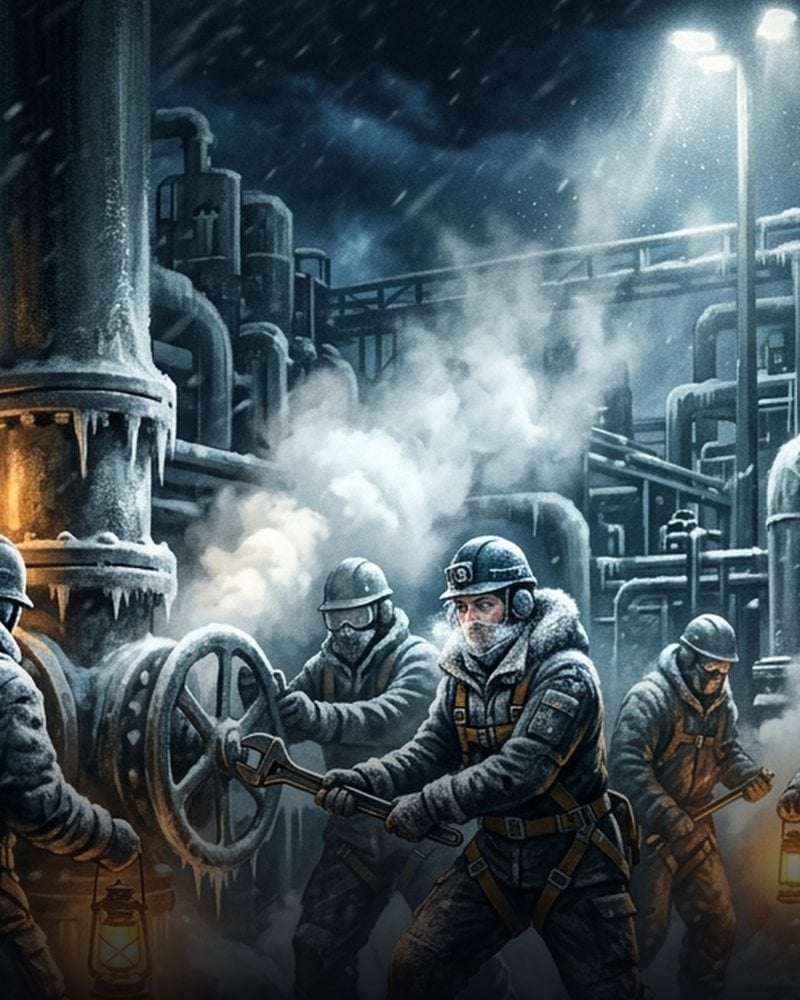
Previously, in Reykjavik, Chief Technician Helga Magnusdottir stabilized the municipal heating lines by hand, leaving her crew to patrol the freezing manifolds on foot while central supervisory computers remained dark.
Salt and Blister Copper at the Southern Mole
The sun struck the southern mole of Valparaiso with an unfiltered Pacific glare, warming the greasy brine pooled between the timber pilings. Moored along the stone quay, five heavy lighters rocked against their hemp fenders, deep in the water with raw blister copper slabs. Chief Tariff Clerk Mateo Rojas stood under a canvas awning pitched against the customs shed wall, dipping a steel nib into an inkwell held steady by an iron paperweight.
Without the digital manifest feeds from Santiago or the port authority's automated crane scales, each slab had to be winched onto the mechanical yardarm balance. Two stevedores swung counterweights into brass trays, their calls echoing over the water—gross tonnage, tare, net yield. Mateo entered the figures stroke by stroke into a folio bound in calfskin, cross-referencing each consignment number against handwritten manifests stamped three weeks before the year turned.
Every consignment sheet for the five lighters bore the same consignor: Sociedad de Fundición Austral. According to the dead telex lines, the firm held clean maritime export permits issued out of Vaduz. Yet when Mateo tallied the weight of the third lighter, the cumulative tonnage exceeded the bonded export threshold by four hundred metric tons. The cargo was real, dense, and physically blocking the mole, but the corporate entity claiming it remained unreachable, adrift in the silence of severed submarine circuits. He marked the margins with three red asterisks, ordered the harbor police to keep the lighter cables secured to the bollards, and turned to the next stack of paper.
The Sub-Zero Loop
Six thousand miles north, the wind off Faxaflói Bay drove pellets of hard snow against the corrugated steel facade of Reykjavik's district pump station. Helga Magnusdottir hauled an eighty-millimeter valve key across the snowdrifts toward the southern intake manifold, her breath freezing immediately upon the coarse wool wrapping her collar. Behind her, two junior mechanics carried portable brass dial gauges and a four-foot steel breaker bar.
With the municipal telemetry system unresponsive since midnight on the thirty-first, the district's district heating network behaved like an unvented steam locomotive boiler. If pressure in the trunk line dropped, subterranean boiling would cavitate the impellers; if it spiked, the cast-iron expansion joints beneath the city streets would sheer under thermal shock. Helga dropped the wrench socket onto the valve stem, slotted the breaker bar through the eye, and signaled her team to lean their weight against the gale.
The spindle gave three reluctant turns, the threads groaning beneath frozen grease before hot sulfur vapor hissed through the gland seal. Helga knelt in the drift, reading the dial gauge she threaded directly into the sample cock. Six-point-four bar. Acceptable for another two hours. She tied a fresh cardboard tag to the yoke, penciled the pressure and timestamp into the moisture-resistant card, and pointed toward the eastern collector. There were sixteen more bypass stations between the harbor and the reservoir hill, and every one of them required muscle before the frost claimed the mains.
The Old Wire in the Cellar
In the basement vaults beneath Vienna's central postal exchange, the smell of damp brickwork competed with the heat radiating from racks of vintage glass vacuum tubes. Telegraph inspector Alois Pelz walked the narrow corridor between the switchframes, holding an induction coil against an insulated cable trunk that had been officially marked as abandoned in 1968. Through his headphones came the sharp, rhythmic flutter of encrypted data bursts, modulated into audio tones to slip through copper lines laid during the reign of Franz Joseph.
The line bypassed the exchange's digital switches entirely. By tapping into the physical copper path linking the old southern railway corridors to the border, someone had established a private high-speed carrier circuit running westward toward Zurich and northwest toward Frankfurt. Pelz followed the cable to a patched terminal block where modern jumper wire had been soldered directly to nickel-plated screw posts. He traced the signal with a needle voltmeter: continuous packet traffic, unlogged by any telecommunications carrier, pulsing quietly through the forgotten bones of the Austro-Hungarian post.
At the Deutsche Börse in Frankfurt, three hundred miles along that same subterranean alignment, forensic investigators sealed off workstation seventeen on the third-floor mezzanine. The terminal had been powered down, its beige plastic case wrapped in red security tape. Console logs extracted from reel-to-reel magnetic backup units showed that at twenty-three minutes past eleven on New Year's Eve, an administrative script had executed from this keyboard, utilizing the root credentials of a senior infrastructure architect who had failed to report to his office since the holiday shutdown. The script had not crashed the mainframe; it had intentionally reindexed the core clearing calendar to January 1, 1899, blinding the transaction monitors while leaving low-level protocol channels wide open for external execution.
Deep beneath Zurich, inside the subterranean vaults of the Swiss National Bank, Senior Auditor Beatrix Keller turned the page of an unrolled green-bar tractor-feed printout. The fluorescent tubes overhead hummed softly against the reinforced concrete ceiling. Her fingernail traced a sequence of twelve wire authorizations executed forty seconds before the clock turned. Every transfer bore the temporal identifier of 1899, routing past the automated SWIFT security traps because the validation filters rejected future dates, not past ones.
Six hundred and forty million Swiss francs had vanished into dormant escrow accounts registered in Vaduz, channeled through the private telegraph track Pelz was currently monitoring in Vienna. On the margin of the final debit slip, printed in pale ribbon ink, was the receiving counterparty: Sociedad de Fundición Austral. Keller set her magnifying loupe upon the desk. The money was gone, the copper in Valparaiso was impounded, and somewhere across the frozen continent, the architect who knew the destination was moving along lines that no living computer was watching.