
Chapter 40
Vaduz Paper and Volcanic Steam
January 10, 2000, 12:00 CET
Previously, senior auditor Beatrix Keller traced six hundred and forty million Swiss francs routed under 1899 timestamps to Vaduz escrow accounts held by Sociedad de Fundición Austral. In Vienna, Alois Pelz monitored the rogue telegraph track, while the missing architect who orchestrated the midnight diversion remained entirely untracked.
The Mezzanine and the Imperial Conduit
Midday arrived in Central Europe not with the chime of synchronized digital clocks, but with the flat clack of manual relay armatures. Deep in the basement vaults of Vienna's central postal exchange, inspectors tracing line impedance found where the modern fiber corridors had been deliberately breached. Beneath dust-caked junction shields installed during the reign of Franz Joseph, four vintage copper conductors hummed with phantom traffic. By tapping an oscilloscope directly into the Austro-Hungarian telegraph trunk, technicians isolated a steady, unlogged packet train: raw financial telemetry siphoned out of Frankfurt and Zurich, routed completely clear of disabled Internet routing gateways, and converted into low-bandwidth pulses directed eastward through vintage switching banks.
Two minutes later in Frankfurt, at the Deutsche Börse core settlement facility, the source of that pulse became indisputable. Forensic investigators in static-control smocks completed their physical cordoning of the third-floor mezzanine. The terminal at station fourteen stood frozen under police tape, its amber CRT monitor reflecting the harsh fluorescents of the raised-floor computer hall. The spool of magnetic tracking tape pulled from the adjacent drive confirmed the intrusion with mechanical indifference: at precisely two minutes before midnight on December 31, the absent senior systems architect's administrative credentials had been keyed directly into the supervisory console. A four-line instruction had suppressed the century-rollover exception handlers and commanded the entire settlement cluster back to January 1, 1899. It was not a hardware failure; it was a scheduled execution.
Down in Zurich, sixty miles south, Beatrix Keller pulled the heavy brass grate shut behind her in the sub-basement archive of the Swiss National Bank. The air in vault twenty-four was cold and still, smelling of bound parchment and machine oil. Armed with the printout rolls from the morning's manual run, she knelt beside three fire-rated steel flat-files marked with red wax audit seals. The paper trails told the story the dead SWIFT networks could no longer broadcast. Millions in sovereign development float had been drawn against the distorted calendar baseline, certified by forged internal overrides, and deposited into unmonitored escrow portfolios chartered in Liechtenstein. With a firm stroke of black ink, Keller endorsed the administrative freezing orders across the metal drawers, halting every pending release tied to the shell entities before stepping toward the security phone to demand the canton prosecutor.
The Quarantined Mole
Four hours later and six thousand miles southwest, the Pacific swell battered the granite riprap of Valparaiso's Southern Mole. Cargo freighters, unable to negotiate automated harbor clearance or receive electronic bills of lading, rode their anchors in disordered lines past the breakwater. On the open quayside, customhouse assayers worked under a harsh midday sun, their clipboards whipped by the salt wind.
Mateo Rojas stood over a row of iron lighters loaded down with dull, raw-edged slabs of blister copper. Behind him, two customs clerks knelt on the timbers, adjusting sliding brass counterweights on a counterpoise scale to verify each skid by hand against thick, handwritten manifests. The metal had been delivered for export under the banner of Sociedad de Fundición Austral, but the paper certificates brought down from the forwarding office were backed only by stamps originating in Vaduz—stamps that Chilean authorities could neither verify nor decline while the coastal telecom trunks remained inert. With the four-hundred-ton consignment far exceeding the company's bonded peacetime limit and no verification forthcoming from Europe, Rojas struck the red refusal stamp into his folio. The lighters would remain under armed guard at the mooring ring until a working line could prove who actually owned the metal beneath the salt.
Pressure Over the Lava Fields
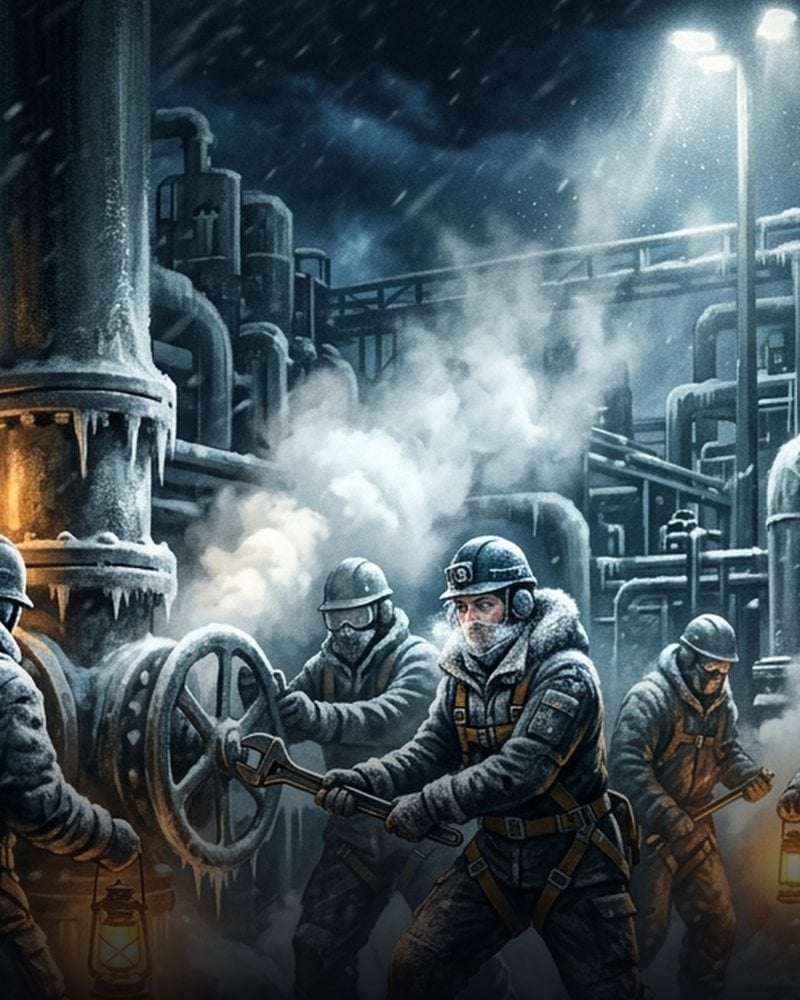
At that same hour on the volcanic plateau above Reykjavik, the wind came screaming off the glacier in a blinding whiteout that dropped visibility to the length of an arm. Chief technician Helga Magnusdottir braced her steel-toed boots against the rime-covered volcanic basalt outside Substation Four, gripping a four-foot valve lever with mittens stiffened by freezing sleet.
With municipal telemetry completely blind since the year-digit dropped into darkness, the municipal geothermal district heating system was flying without instruments. Steam mains, charged by superheated deep-well boreholes, risked rupturing beneath the residential districts if pressure built unchecked behind frozen distribution lines. Magnusdottir's team moved from concrete bunker to bunker along the pipeline path on an unyielding sixty-minute rotation. Inside the tiny valve shed, illuminated only by a battery inspection lamp, she checked the mechanical Bourdon gauge against a hand-drawn grease-pencil tracking chart posted to the corrugated iron wall. Leaning her full weight onto the bypass throttle, she eased the bypass gate three turns toward open, hearing the shriek of high-pressure steam divert into the relief duct. The needle steadied within the safe green band, but as she stepped back into the blizzard toward the next station, the station phone remained dead on its cradle, leaving her crew isolated on the freezing plateau with no indication of when the town below would answer.