
Chapter 41
The Sovereign Siphon
January 10, 2000, 23:50 CET
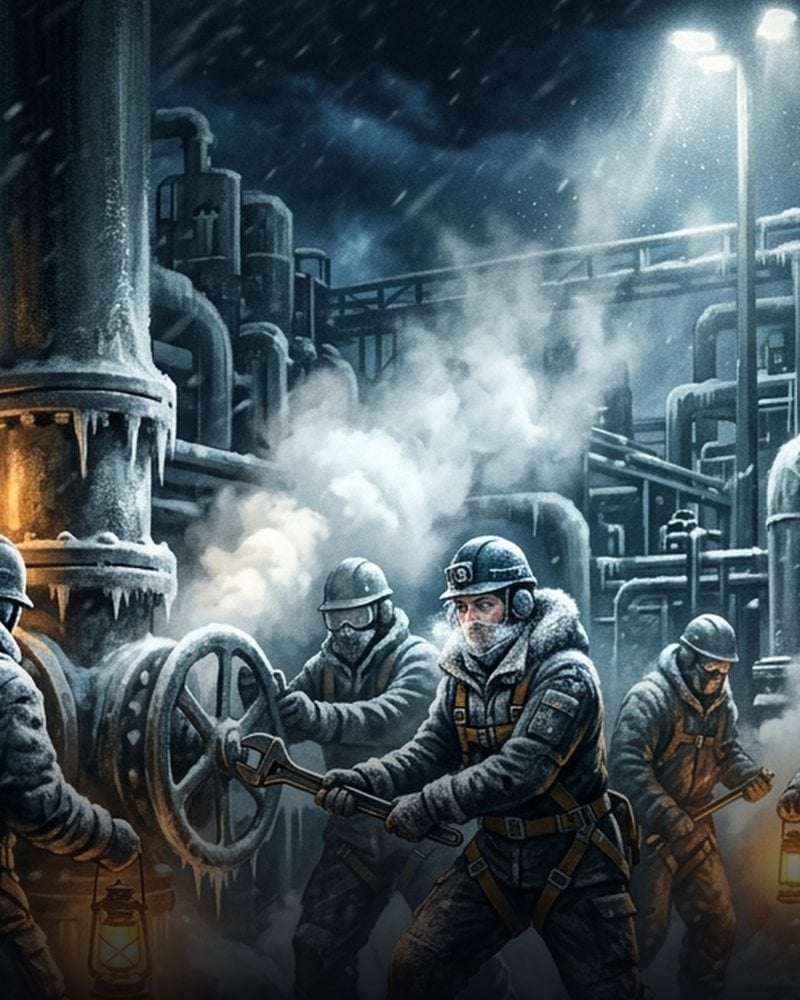
Previously, on the frozen outskirts of Reykjavik, Chief Technician Helga Magnusdottir kept the municipal heating network from rupturing under pressure by manually easing geothermal bypass valves on a strict rotation, entirely cut off from the dead telemetry below.
Quarantine at the Southern Mole
The night air over Valparaiso tasted of diesel oil and cold Humboldt spray. Along the Southern Mole, cargo cranes hung silent against the Pacific dark, their cables swaying like gallows ropes in the southwesterly gusts. Under the glare of portable tungsten floodlights rigged to a sputtering generator, Chief Tariff Clerk Mateo Rojas stood with his coat collar turned up against the salt mist, watching two inspectors heft an ingot of blister copper onto the brass balance scale.
The counterweights clattered against the iron deck. A customs runner chalked the tally onto a slate: ninety-four pounds, seven ounces. It was ingot number three hundred and twelve of a four-hundred-metric-ton consignment consigned to Sociedad de Fundición Austral, and Rojas had no intention of letting a single slab leave the pier.
"The manifests bear the official Vaduz stamp, señor," the shipping agent insisted for the fourth time that night. His knuckles were raw red from the wind as he brandished the damp paper under Rojas's brim. "Cleared by the joint European customs pool on the thirty-first. You have no legal warrant to impound bonded metal."
"The stamp is ink on paper, señor Bravo, and the telegraph cable north has been silent since midnight on the thirty-first," Rojas said without looking up from his tally sheet. He tapped the column of figures with the brass tip of his pencil. "Your Vaduz certificate asserts an export quota drawn against an account registered in 1899. A clerical absurdity, or an outright theft disguised by the dead wires. Until the maritime line to Callao answers, or an overland courier brings a stamped clearance from the ministry in Santiago, this copper stays stacked within customs chain. Every ounce."
Out beyond the breakwater, two quarantined lighters rocked against their moorings, heavy with detained ore that no tug had clearance to haul toward the open roadstead.
The Forty-Minute Watch
Five thousand miles away on the Hellisheidi plateau, the blizzard stripped paint from the corrugated sheet-metal siding of valve station seven. Helga Magnusdottir wiped the frost from her woolen face wrap with a heavy mitten, her steel-toed boots crunching through wind-packed rime as she guided her second-shift fitter into the trench.
The telemetry bank inside the bunker remained dead, its digital indicator arrays showing only hollow gray bars. There was no automated telemetry to balance the flow between the superheated boreholes and the municipal radiator grids below the capital; if high-pressure steam sat stagnant behind frozen district gates, the mains would shatter like glass. Every forty minutes, by the ticking of the mechanical pocket watch pinned inside her parka, Magnusdottir and her crew operated the high-pressure wheel by hand.
"Watch the Bourdon tube," she ordered, shining her halogen torch onto the circular bronze dial. "Don't trust the casing. Feel the bypass sleeve before you seat the dog."
Together, she and the fitter slid a two-meter length of galvanized pipe over the spoke of the primary throttle. With a synchronized heave, their breath fogging white against the sweating valves, they forced the iron disc four notches against the spring. A scream of wet steam tore through the relief conduit, shaking the concrete beneath their boots until the needle drifted from the red hazard mark back into the safe black band. The pipe groaned, expanding in its cradles, but the seals held.
Magnusdottir dropped the cheater bar onto the gravel floor with a dull thud. Her lungs burned with the sour mineral stench of sulfur. She glanced at the dead wall telephone, then back toward the blizzard raging outside the blast doors. They had eighty minutes before station four would need the same intervention, and no way to know how much longer the boilers below could stand the strain.
The Siphon in the Basements
In Zurich, the cold had penetrated deep into the basement vaults of the Swiss National Bank. Senior Auditor Beatrix Keller walked the row of grey steel filing cabinets in Vault Twenty-Four, a heavy brass padlock swinging from her fingers. Under the buzz of emergency fluorescent strips, she slammed shut the bottom drawer of cabinet six and snapped the padlock home.
On the mahogany sorting table lay three sets of dot-matrix transaction ledgers, ripped along the tractor perforations. Across seven pages, the story was unmistakable: seconds before midnight on New Year's Eve, three sovereign development accounts had dumped six hundred and forty million Swiss francs into Liechtenstein escrow holdings. The transactions had slipped through the interbank gate because an embedded subroutine had backdated the release authorization to January 1, 1899—a date for which no automated digital reconciliation rules existed. Keller marked each transfer in red ink, signing her name across the security seal. The wires were frozen, but the money was already gone, dispersed into dormant corporate shells whose owners were names written on paper filed in Vaduz vaults.
Three hundred miles north, in the mezzanine of the Deutsche Börse in Frankfurt, IT investigator Eberhard Falk stood over an isolated mainframe workstation behind barrier tape. The terminal had been severed from the network backbone, its yellowed display tethered only to a standalone thermal printer. Falk unspooled the paper ribbon, his thumb following the system log. At precisely 23:58 on December 31, a four-line instruction had been typed directly into the console using root credentials belonging to a senior systems architect who had not reported for work since the holidays began. The script had not failed; it had performed its function with surgical precision, telling the system clock to accept 1899 as current time and unlatching the settlement gate.
In the vaulted cellars of Vienna's central postal exchange, the final piece of the conduit surfaced. Alois Pelz adjusted the flame of his kerosene lantern against the damp brickwork of the subterranean conduits. Below the racks of dark, silent digital fiber runs lay the decommissioned copper trunks of the old imperial telegraph. One of the heavy lead-sheathed bundles hummed with an irregular, rhythmic pulse.
Pelz brought his test handset close. Clipped across the corroded nineteenth-century terminals was a newly soldered jumper harness, drawing juice from an auxiliary battery pack. High-frequency bursts were chattering through the antique copper wire, entirely outside the modern digital packet switches, routing private encrypted streams southeast toward the Balkans. Someone had understood long before midnight that when the modern world fell blind, the old wires would still carry the gold.