
Chapter 38
The Nineteenth Century Trap
January 10, 2000, 11:57 CET
Deep within the Swiss National Bank's subterranean vaults, senior auditor Beatrix Keller traced the century-date rollback to a deliberate siphon, identifying dormant shell accounts that mirrored cargo records from an impounded Chilean lighter.
The Austro-German Corridor
On the third-floor mezzanine of the Deutsche Börse in Frankfurt, the computer floor had been taped off behind yellow security cordons. Forensic specialists worked in quiet pairs beneath strip fixtures, lifting spools of half-inch magnetic tape directly from the tape drives of the primary clearing mainframes. The amber phosphor screen of terminal twenty-four still held the execution buffer from New Year's Eve. When investigator Stefan Lindner ran the keystroke replay against the console's physical memory register, the sequence unresolved into a cold certainty: at 23:58 on December 31, an administrative override had forced the system calendar back to January 1, 1899. The access token belonged to the senior infrastructure architect who had failed to report to his shift four hours earlier. His personal locker was empty; his electronic passcard had been swiped at the perimeter gate at twenty past ten and never clocked out.
Five hundred miles to the east, inside the vaulted basement of Vienna's central telegraph hall, postal inspectors were discovering where that forced temporal rollback had been aimed. The room smelled of hot bakelite and heated vacuum tubes. Long before modern fiber backbones had linked Central Europe, the imperial post had routed signals along thick subterranean copper bundles running through Habsburg rail tunnels toward the Swiss frontier. Inspector Alois Brandl followed a pair of braided lead jumper cables spliced crudely into a rack of deactivated 1940s rotary relays. An oscilloscope rested on a wooden bench beside the jumpers, its green trace pulsing with packet bursts. The digital routers upstairs had choked on the year change, but down here, shielded from modern monitoring gateways, encrypted financial telemetry from Frankfurt and Zurich was coursing freely over vintage wire tracks toward Alpine junction boxes.
In Zurich, sixty feet below the Paradeplatz inside the reinforced archive vaults of the Swiss National Bank, Beatrix Keller slapped an administrative freeze order onto three steel flat-files. Around her, auditors checked green-tinted printouts line by line against bound currency registers. The anomalies were staggering. By forcing mainframe clocks into 1899, the rogue commands had tripped automated reconciliation routines into an infinite clearing loop: sovereign development funds allocated for interbank settlement had cleared the debit phase but could not settle on recipient ledgers that required four-digit year values. The unmapped float—over six hundred million Swiss francs—had been funneled through the Vienna telegraph siphon directly into dormant escrow accounts registered in Vaduz during the reign of Prince Johann II. When Keller ran the title search on the primary receiving entity, the name printed on the ticker tape matched letter for letter: Sociedad de Fundición Austral.
Valparaiso Harbor
Rain slanted over the southern mole of Valparaiso, carrying the salt reek of the Pacific against rows of corrugated warehouses. In the harbor roadstead, eighteen container freighters and bulk ore carriers swung on their anchor cables, their diesels rumbling in idle while water taxis ferried sodden manifests back and forth to the quay. The customs clearing house had been stripped of its workstations; the monitors sat dead along the wooden benches, their power cords coiled and tied with hemp twine.
Chief Tariff Clerk Mateo Rojas stood under a sputtering kerosene hurricane lamp, his fountain pen scratching over an open ledger of rag paper. Before him stood the skipper of an offshore lighter, dripping bay water onto the timber planking while clutching a stack of damp cargo manifests. Rojas held each bill to the light, checking the weight declarations against the physical brass beam balances stationed at the wharf edge, where customs men hoisted copper ingots one crate at a time to verify tonnage against paper bills.
"The computer told you forty tons before midnight on the thirty-first," Rojas said, tapping the ink-blotted bill of lading with the back of his thumb. "Now the digital manifest says zero, and your barge sits four inches below its waterline. We weigh every pig by hand, or you swing out there until February."
The lighter's cargo was consigned to the very same Vaduz shell firm uncovered beneath Zurich: Sociedad de Fundición Austral. Thousands of metric tons of high-grade blister copper sat immobilized along the quayside, unable to obtain clearance stamps while the Chilean customhouse arbitrated disputes with nothing more than hand balances, lead seals, and handwritten ledgers. Offshore, the anchor lights of waiting vessels formed a jagged constellation across the dark water.
The Reykjavik Geothermal District
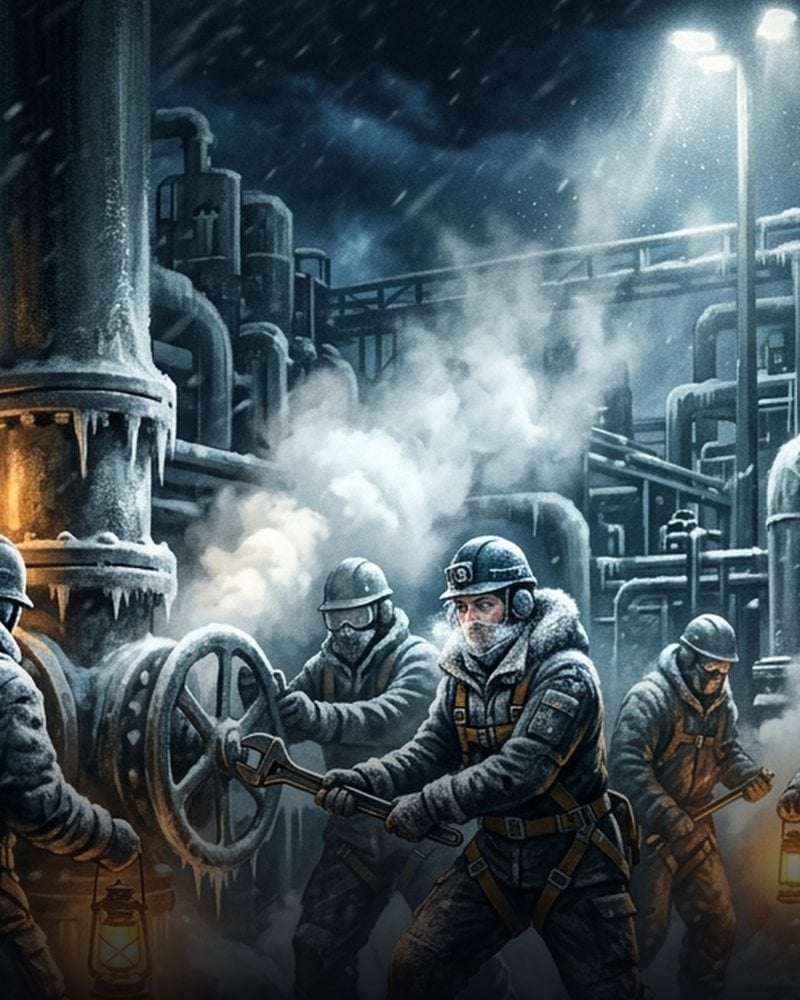
North across the Atlantic, the gale out of the Denmark Strait slammed against the exterior manifolds of Reykjavik's municipal geothermal pumping station. Ice caked the corrugated steel exterior of the turbine house in sheets six inches thick. Inside the primary manifold trench, Chief Technician Helga Magnusdottir hauled on a six-foot steel cheater bar clamped to the main bypass valve, her boots bracing against iron decking coated in frozen brine.
With the plant's remote telemetry units paralyzed by date-parsing rejections at the stroke of midnight, the automated pneumatic valves had drifted closed, threatening to drop steam pressure across the entire western residential sector to zero. If the boiling water stalled in the feeder mains beneath the streets, the sub-zero permafrost would split hundreds of miles of cast-iron district heating pipe before sunrise.
"Hold the collar!" Helga shouted over the screech of the storm rattling the louvers. Two mechanics in oilskin parkas threw their weight against the secondary linkage, steadying the counterweight as Helga threw her weight into the lever. With a dull metallic groan that vibrated up through their boots, the valve cracked open a quarter turn. The dial on the mechanical Bourdon pressure gauge shuddered, its needle climbing sluggishly out of the red sector toward four bars.
Helga wiped grease and condensed steam from her forehead with a heavy wool mitten. She checked the mechanical flow meter mounted to the bulkhead, noting the gallons-per-minute on a cardboard tag wired to the housing. The pressure had stabilized, but the supervisory computers on the mezzanine remained dark slabs of cold plastic. To keep the city alive, her teams would have to walk the manifold line every two hours on foot, rotating through the freeze with flashlights and heavy wrenches while the wider world tried to figure out who had broken the clocks.