
Chapter 37
The Architects of Midnight
January 10, 2000, 11:56 CET
Previously, Chief Tariff Clerk Mateo Rojas continued clearing quarantined cargo lighters along the Valparaiso docks, only to uncover a shortwave manifest bearing the exact name of a phantom holding company identified in Zurich's frozen vaults.
Salt and Steam
The tide battered the pilings beneath Valparaiso's southern mole, throwing a fine, brine-laden spray over the wooden staging platforms where customs inspectors had set up their heavy brass beam balances. With automated manifest routing paralyzed by unparsed date scripts, the harbor had ground to an agonizing crawl. Every vessel riding anchor in the roadstead had to be cleared by human eye and muscle. Senior Inspector Mateo Rojas stood wrapped in his wool watch-coat, checking the balance arm of a counterweighted beam scale as two dockworkers lowered a sling of copper ore ingots onto the wooden pan.
Beside him, representatives from the Valparaiso Export Syndicate shifted impatiently on the salt-crusted flagstones. The syndicate men kept their eyes fixed on the heavy parchment ledgers where Rojas entered each gross tare and net tally by hand in indelible ink. The automated telemetry from the maritime board remained entirely dark, yet the commercial pressure had not diminished. The syndicate's cargo lighters had backed up past the outer breakwater, their crews shouting through megaphones across the choppy bay. Rojas took his time, waiting for the brass pointer to settle true on the index before dipping his steel nib. The shortwave radio dispatch he had intercepted earlier that morning still sat folded inside his breast pocket—a transmission listing a consignee whose corporate registration had vanished from public registers in 1900, yet matched letter for letter the dormant holdings under scrutiny thousands of miles away in Central Europe.
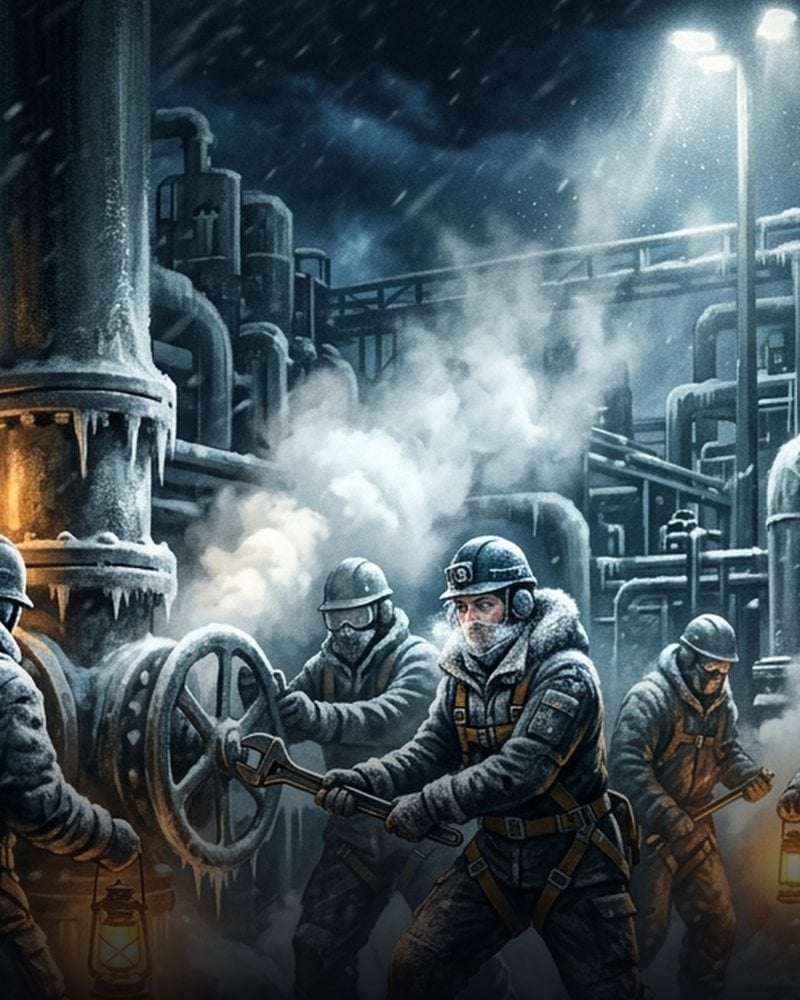
Across the Atlantic, nearly three thousand miles north beneath the Arctic circle, the struggle against systemic collapse wore a much colder face. In Reykjavik, howling gale-force winds swept off Faxaflói Bay, driving hard pelting snow against the corrugated steel siding of the municipal geothermal station. The facility’s automated telemetry units remained trapped in cyclical reboot loops, leaving the capital's district heating network blind to pressure spikes in the subterranean mains.
Chief maintenance technician Helga Magnusdottir led her four-person crew along the exterior manifold gangway, their heavy oilskin parkas stiff with rime. Hand-held kerosene lanterns cast yellow circles across the frost-bloomed steel piping. If high-pressure geothermal steam stalled in the bypass valves, the sub-zero chill would seize the distribution loops within hours, cracking municipal lines buried beneath the city streets. Helga fitted a long-handled iron valve wrench over the frozen wheel of the primary throttle. She braced her boots against the icy grating, nodding to her lead fitter. Together they threw their weight into the lever. The valve stem broke free with a sharp metallic snap, discharging a shriek of superheated steam into the blizzard as the bypass reopened, stabilizing pressure across the grid before the freeze could take hold.
The Continental Conduit
In the cordoned-off basement computer suites of the Deutsche Börse in Frankfurt, the air remained dry and warm, smelling of warm synthetic resin and magnetic tape. A team of forensic investigators worked under federal police supervision, cataloging console printouts and replaying reel-to-reel audit reels taken from the core settlement mainframes. The digital clock rollback that had crippled German bond valuation algorithms at midnight had left behind an unmistakable signature.
By tracing the internal command hierarchy back through the master console logs, the investigators isolated the physical terminal and administrative user credentials responsible for the intrusion. The rollback to an 1899 baseline had not been triggered by an unhandled calendar overflow or a compiler flaw. It had been manually initiated from a workstation on the third-floor technical mezzanine, authenticated under the root profile of a senior systems architect who had logged off fifteen minutes before midnight and failed to report for his morning shift. Every command had been structured to force system clocks backward into an unmonitored baseline, blinding transaction safeguards while leaving secondary execution pipelines open.
Four hundred miles to the southeast, within the labyrinthine cellar of Vienna’s central telegraph and telephone exchange, postal engineers were uncovering the destination of that blind pipeline. Working beneath racks of glowing vacuum tubes, technicians traced an anomalous electric hum running along obsolete copper tracks laid during the Austro-Hungarian monarchy. These abandoned imperial circuits had long been decommissioned from civic use, yet their mechanical relays were chattering steadily.
By inserting manual patch cords into vintage plug boards and monitoring paper tape relays, the inspectors intercepted an active siphon. Packets of encrypted financial data were flowing in continuous bursts out of Frankfurt and Zurich, routed through the analog Austrian lines to bypass international digital gateways entirely. The data streams carried archaic 1899 routing headers, designed to pass through dead exchanges without triggering modern SWIFT automated audit bells.
In Zurich, deep within the reinforced subterranean vaults of the Swiss National Bank, Senior Auditor Beatrix Keller sat surrounded by stacks of tractor-feed printouts and century-old handwritten ledgers. Under the focused light of green-shaded emergency desk lamps, she matched the anomalous transfer streams against isolated mainframe logs.
The mechanism was brutally clear. The forced date rollback to 1899 had exploited legacy calendar subroutines within the bank's core accounting software, creating a phantom ledger loop where funds ceased to exist in sovereign accounts but had not yet landed in recipient ledgers. Through that deliberate blind spot, hundreds of millions of francs in sovereign development assets had been siphoned into dormant Liechtenstein escrow accounts. The shell corporations controlling those accounts bore names that had not conducted legitimate business since the late nineteenth century. Beatrix underlined a single account title in red ink, recognizing the exact name that had surfaced hours earlier on the cargo sheets of an impounded copper lighter in Valparaiso.