
Chapter 36
Subterranean Shadows and Cold Counterweights
January 10, 2000, 10:10 CET
Previously, the paralysis of Frankfurt's digital settlement infrastructure forced regional German industries into direct barter, as Swabian textile weavers and Ruhr coal syndicates traded wool for fuel using ink-signed paper warrants.
Quarantined Lines in Central Europe
Before dawn broke over Vienna, the air inside the central telegraph and telephone exchange hung thick with the dry heat of overworked vacuum tubes and ozone. Technicians had spent the night tracing the phantom hum that bypassed their emergency switchboards, guided only by hand-held galvanometers and the faint flutter of relay switches. Behind a flaking plaster partition near the subterranean cable culvert, an inspector discovered a forgotten junction box dating to the late Austro-Hungarian monarchy. Tied directly into the oxidized brass terminals was a spliced copper jumper loop, newly insulated with modern black polyvinyl tape. It was an unauthorized tap that drew power from the dead line's residual voltage, siphon-routing financial telemetry packets out of Germany and Switzerland through archaic telegraph tracks never cataloged in the city's modern digital routing tables.
Four hours west in Zurich, the same invisible undercurrent surfaced in physical ink. Deep within the reinforced vaults of the Swiss National Bank, three floors below the frost-stiffened streets, senior auditor Beatrix Keller sat before double-banked rows of green cloth ledger books. Beside her, electric sorting tables lay dark, severed from the international SWIFT network after the midnight rollover injected nonsensical 1899 strings into the wire queues. Keller worked methodically with a steel bone folder and grease pencil, cross-referencing printed exception sheets against hand-bound depositor registries from the turn of the century.
What she found was not the erratic corruption of random system decay, but deliberate architecture. Three newly formed holding companies—incorporated in Liechtenstein and registered with shell domiciles in the Channel Islands—carried transaction routing prefixes coded specifically to trigger the 1899 fallback subroutine. Under the guise of software failure, sovereign development funds had been drawn into unmonitored escrow balances seconds before the system froze. The dates had not glitched; they had provided cover. Every document she turned over bore the neat, mechanical imprint of a script configured weeks before the new year to siphon billions into dead air the instant the clock turned.
Northern Balances in Stockholm and Oslo
Across the Baltic, the crisis was met not with secrecy, but with raw timber and iron. By mid-morning on Gustav Adolfs Torg in Stockholm, the cold was sharp enough to freeze breath on wool scarves. With electronic equity and bond exchanges frozen indefinitely across Scandinavia, the exchange directors completed an emergency expansion of their open-air trading post. Four additional pine-timber booths, smelling sharply of resin and fresh sawdust, had been hammered together along the cobblestones. Beneath canvas awnings, clerks warmed their inkpots over charcoal braziers and validated trade warrants with heavy carved wooden stamps and dark red beeswax seals.
Merchants lined the plaza holding physical warehouse receipts for northern timber and Kiruna iron ore, swapping parchment scrip against stamped copper tally tokens. The rhythm of Scandinavian trade had regressed nearly a century in the span of ten days, yet the plaza functioned with rigorous, punctilious discipline. Even as corporate directors in London and New York waited helplessly for mainframe diagnostic routines to compile, Stockholm's timber exchange completed four hundred bulk cargo transfers before noon, all authenticated by the physical press of brass rings into hot wax.
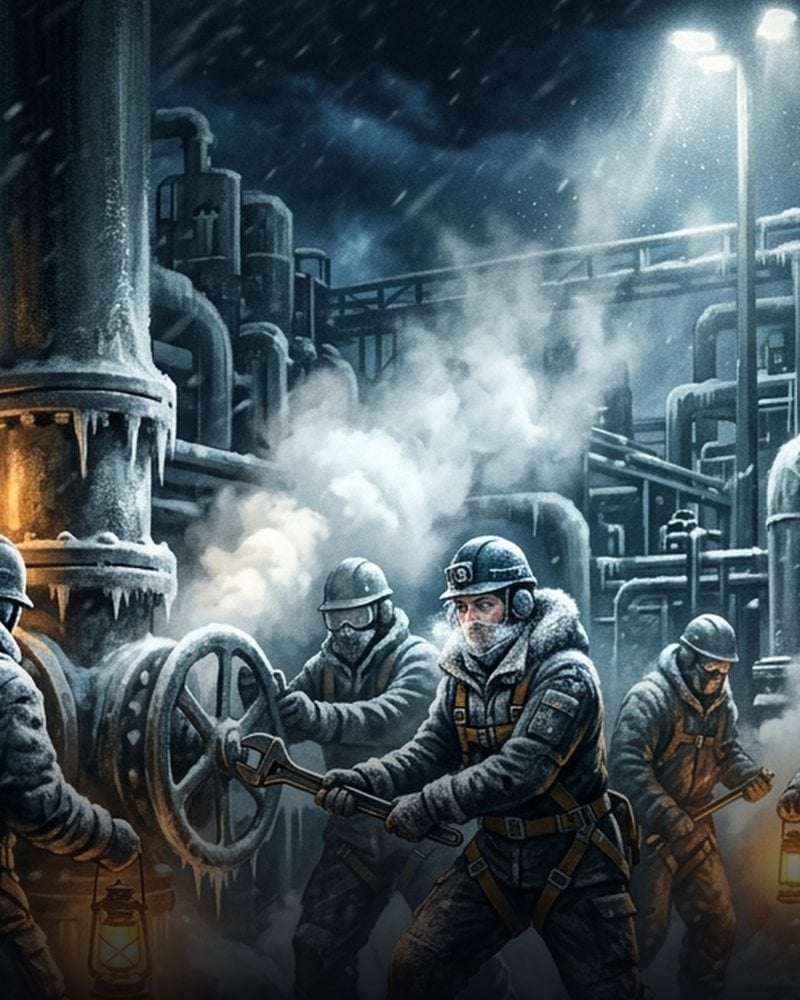
Two hundred miles to the west, the fight was not for capital, but for warmth. In Oslo, the municipal gasworks had reached a critical threshold when automated telemetry units permanently locked up on an unparsed 1900 date-index offset, leaving the distribution network blind. With pressure gradients fluctuating wildly toward the blast valves, city engineers abandoned the control room's dark monitor screens and descended into the valve basements. Guided by dusty linen blueprints recovered from the municipal archives, crews hauled massive nineteenth-century cast-iron counterweights from dead storage and bolted them directly onto the main pressure-reduction diaphragms. By balancing the physical gravity of the hanging plates against the incoming wellhead rush, the crews stabilized pipeline velocities across the capital by hand, holding the frozen city back from total mechanical failure.
The Southern Mole at Valparaiso
Across the equator, under the bright morning glare of the Chilean summer, the Pacific harbor of Valparaiso groaned under the weight of immobilized commerce. At the southern mole, where the salt air bit at the iron fittings of moored cargo lighters, customs inspectors were slowly untangling a maritime gridlock that stretched three nautical miles into the bay. Automated container scanning systems and electronic tariff databases had severed connections at midnight on New Year's Eve, stranding hundreds of export lighters laden with high-grade nitrate and bagged copper concentrates.
Customhouse officers refused to release a single hull into international waters without verification. Working directly on the salt-crusted docks, inspectors under Chief Assayer Mateo Rojas set up heavy brass beam scales salvaged from the old bonded customs shed. Four-man stevedore gangs hoisted canvas sacks of nitrate onto the balance plates, checking each load against calibrated counterpoise weights while clerks recorded the tallies in thick canvas-bound ledgers.
By mid-morning, the line of detained lighters had begun to creep forward, cleared bag by bag under the tactile scrutiny of the weights. Yet as Rojas stamped clearance papers for a coastal steamer bound for San Francisco, a discrepancy emerged between the ship's physical tonnage and an unverified manifest transmitted through Valparaiso's intermittently resurrected shortwave radio. The manifests cited an offshore holding entity that matched, letter for letter, the nomenclature appearing in Zurich's frozen vaults—a phantom account with no physical factory, waiting for cargo that had officially ceased to exist.