
Chapter 16
Global Conduits and Fractured Control Panels
January 4, 2000, 16:30 JST
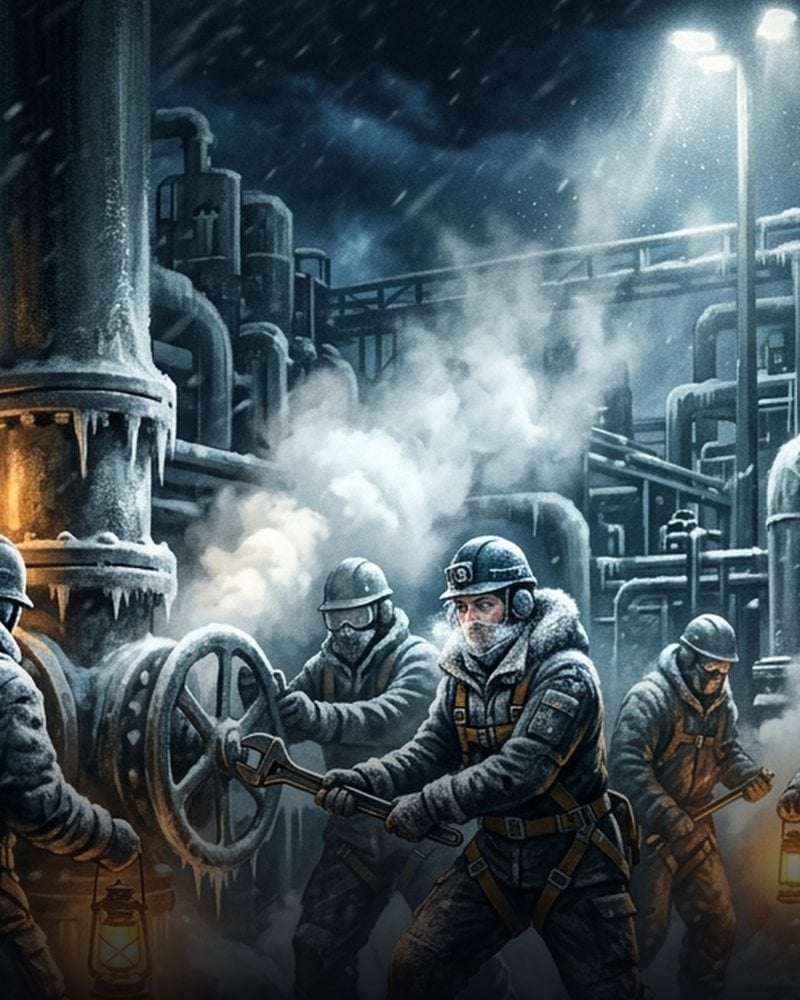
Previously, telecommunications engineers in Reykjavik worked through freezing conditions to solder custom copper jumpers onto multiplexer chips, stabilizing the fragile data bridge connecting European and North American financial exchanges.
Grid Instability and Financial Shadows Across the Atlantic and Europe
In the predawn hours across the Venezuelan capital, Electricidad de Caracas engineers fought an escalating crisis at the Guarenas substation. As automated frequency synchronization mechanisms failed across the metropolitan area, technicians were forced to operate substation regulators entirely by hand. A sudden surge in industrial demand combined with sluggish manual turbine adjustments pushed the station to the brink of a complete thermal overload, threatening a cascading blackout across the city as manual governor controls struggled to stabilize power distribution following turbine clock failures.
A few hours later in the bitter sub-zero cold of Iceland, telecommunications technicians at the Reykjavik cable landing station worked frantically to maintain the fragile international data link. Facing catastrophic packet loss and recursive routing loops across transatlantic trunk lines, they successfully soldered custom copper jumpers onto multiplexer buffer chips, bypassing corrupted hardware to stabilize the last surviving low-latency data pipe between North American exchanges and European financial markets.
By morning in Zurich, senior auditor Beatrix Keller expanded her forensic investigation deep within the secure auditing rooms of the Swiss National Bank. Her team mapped out a complex web of unauthorized wire transfers executed during the midnight Y2K transition, identifying encrypted transaction logs that linked the 1899 date-string vulnerability directly to dormant Swiss shell accounts. Cross-referencing corrupted transaction metadata with manual SWIFT logs, the investigators realized the manipulation was not a random glitch, but a calculated cyber intrusion designed to mask the extraction of sovereign financial reserves.
Port Standoffs and Manual Skies in the Pacific
Later that day in the Southern Hemisphere, tensions boiled over at Port Jackson in Sydney. With automated port berth systems entirely frozen from date-parsing faults, port officials insisted on keeping container cranes running using auxiliary VHF radios and handwritten tallies as paper manifests piled up without digital weight verification. Maritime trade union representatives and port authority managers locked horns over the safety of manual crane hoisting operations, prompting union delegates to walk off the loading platforms and refuse to hoist heavy industrial containers without computerized ballast and weight confirmation, citing severe risks of structural crane failure.
As evening fell across Japan, civilian air traffic controllers and military radar officers in Tokyo collaborated to guide incoming trans-Pacific flights entirely by hand. With automated altitude-encoding processors failing across Japanese airspace, Haneda Airport's control tower reverted to Cold War-era procedures, tracking incoming aircraft via primary radar sweeps and manually plotting flight paths on vertical plexiglass boards to maintain safe vertical and horizontal separation for heavy long-haul arrivals. The improvised paper and glass methods kept the skies safe for now, but the fragility of the global network remained unresolved as new night-shift logs began to pile up.