
Chapter 38
Hardening the Lines
November 22, 2142
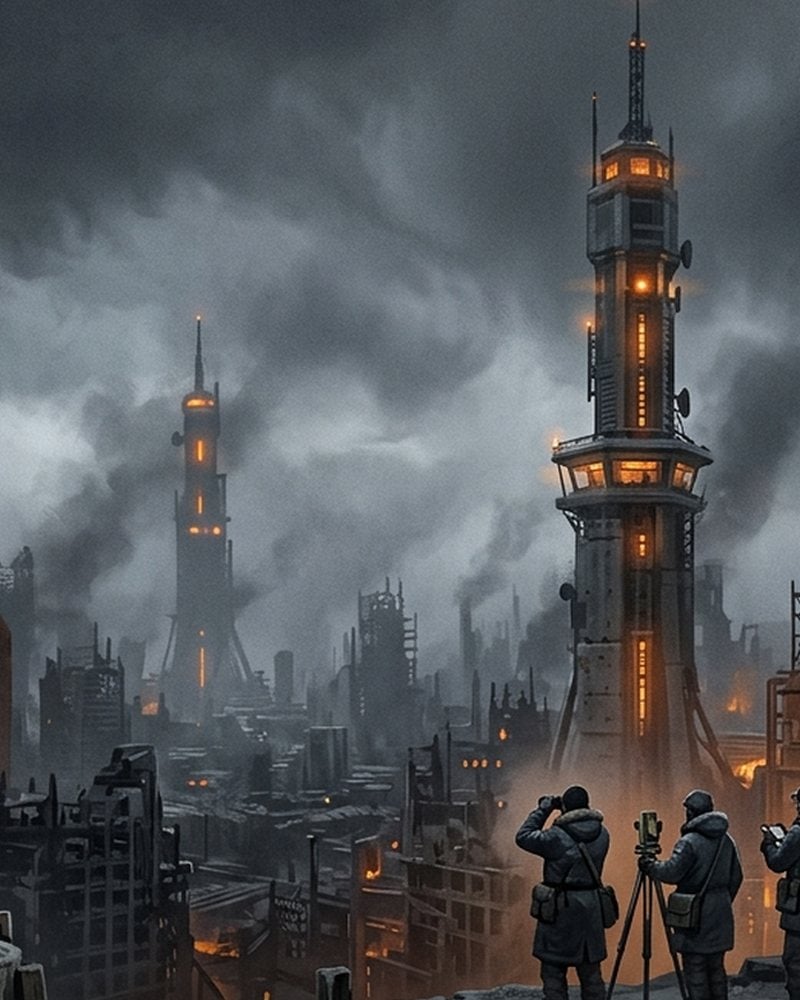
Previously, in Last Light, Technocrat engineers stabilized meteorological sensors along the outer industrial perimeter following an acid squall, while automated listening arrays logged persistent, rhythmic low-frequency signals echoing from the abandoned transit tunnels beneath the city core.
The Northern Exchange Yard
Inside the fortified caravanserai's central granary, tallow lanterns cast long shadows across heavy oak tables scored deep by decades of tally marks. The room smelled of dried grain dust and smoked jerky. Around the perimeter, sentries in boiled leather and scrap-plate leaned against the timber bracing, listening to the monotonous scrape of bone styluses against wax tablets as independent freight captains settled their seasonal ledgers.
The ratified two-percent merchant levy was no longer a matter of debate. Sula, speaking on behalf of the northern dune clans, watched as the caravanserai weigh-masters scooped hard red hydroponic kernels from inbound crates into communal measuring hoppers. For every fifty measures hauled through the basalt gates, one went directly into the granary silos flanking the yard. Merchant haulers who had grumbled through three weeks of negotiations offered little resistance; the price was paid not in syndicate scrip, but in bulk provisions that guaranteed armed outriders along the gravel tracks.
By midday, the final ledgers had been sealed with hot resin. The cooperative exchange rates locked scrap iron, dried meat, and purified water into fixed ratios that insulated the northern basin from the predatory swings of the southern markets. Beyond the granary walls, teamsters were already hitching armored tread-haulers and draft beasts for the season's first organized supply convoy. With the granary stocks swelling and escort rotations posted along the barracks boards, the autonomous northern exchange had transitioned from a fragile truce into an operating system.
Valves of the Iron Sinks
Deeper in the city's flooded underbelly, work progressed under the yellow glare of portable auxiliary glow-lamps hooked to exposed pipework. Rust Syndicate enforcers kept their carbines slung low across their chests, boots planted in inches of alkaline runoff as they supervised the reinforcement of the primary filtration vaults. Behind them, the iron catwalks groaned whenever the massed crowd in the outer tunnels pressed forward against the perimeter fence, their shouts muffled by the continuous churn of the drainage sumps.
A maintenance detail hauled bags of dry quick-setting cement down the service stairs, slicing the paper sacks open with rusted shivs and dumping the gray powder into steel mixing troughs. Slurry hoses hissed, pumping dense, lime-heavy concrete into raw wooden forms bolted directly over the master intake manifolds and historical junction points. Syndicate foreman Kove leaned over the edge of the lower formwork, checking the depth of the pour with an iron rebar rod to ensure the wet mix completely engulfed the valve housings.
The barricades were an answer to the flexible polymer bypasses that underground resistance teams had burrowed through the lower masonry. Syndicate sweeps had already located and crushed two secondary lines that morning, but clean water was still bleeding out of the main arterial pressure gauges, routed downward into the slums by hidden conduits. As the slurry hardened into cold, immovable gray stone, the enforcers drove iron spikes into the curing faces to discourage picks and sledgehammers. The syndicate was deliberately entombing its own secondary service valves to starve the unauthorized taps, gambling that brute mass would hold the perimeter until the crowds broke.
Sensor Calibration on the Spires
Miles to the south, high above the rust-streaked roofs of the outer industrial sector, Technocrat survey engineers worked suspended along the girders of the meteorological spires. The caustic acid front from the previous shift had passed, leaving behind pools of corrosive condensation that hissed softly against the galvanized steel towers. Wind off the dead basin buffeted their safety harnesses as they worked in pairs, hauling portable chemical desiccant canisters and coiled heat lines up the oxidized external ladders.
Survey technician Danas clamped a magnetic bracket to the cross-arm of the upper mast and unrolled a portable infrared heating strip, wrapping the flexible coil directly around the housing of the atmospheric telemetry cluster. Moisture trapped inside the sealed casing had caused persistent short-circuits, bleeding signal integrity and dropping packet transmission rates across the district survey array. With the heating elements energized from hip-mounted battery packs, a pale halo of steam lifted from the housing, venting through emergency desiccant plugs tapped into the service port.
Below them, the city sprawled in an uneven patchwork of dark corridors and fortified hubs, with only occasional clusters of arc lamps marking the syndicate strongholds. As the heat coils did their work, the diagnostic readouts on Danas's wrist monitor shifted from amber warnings to steady green status bars, confirming that dry air was restoring the junction pins. The primary data feed re-established its link with the central command grid, transmitting ambient pressure and wind vectors without distortion. Yet interspersed between the clean weather telemetry, the low-frequency background monitor continued to capture rhythmic, low-amplitude pulses drifting up from the drowned transit tunnels below.