
Chapter 34
Seals, Scales, and Quarantined Tones Across Continental Nodes
January 9, 2000, 03:20 WET
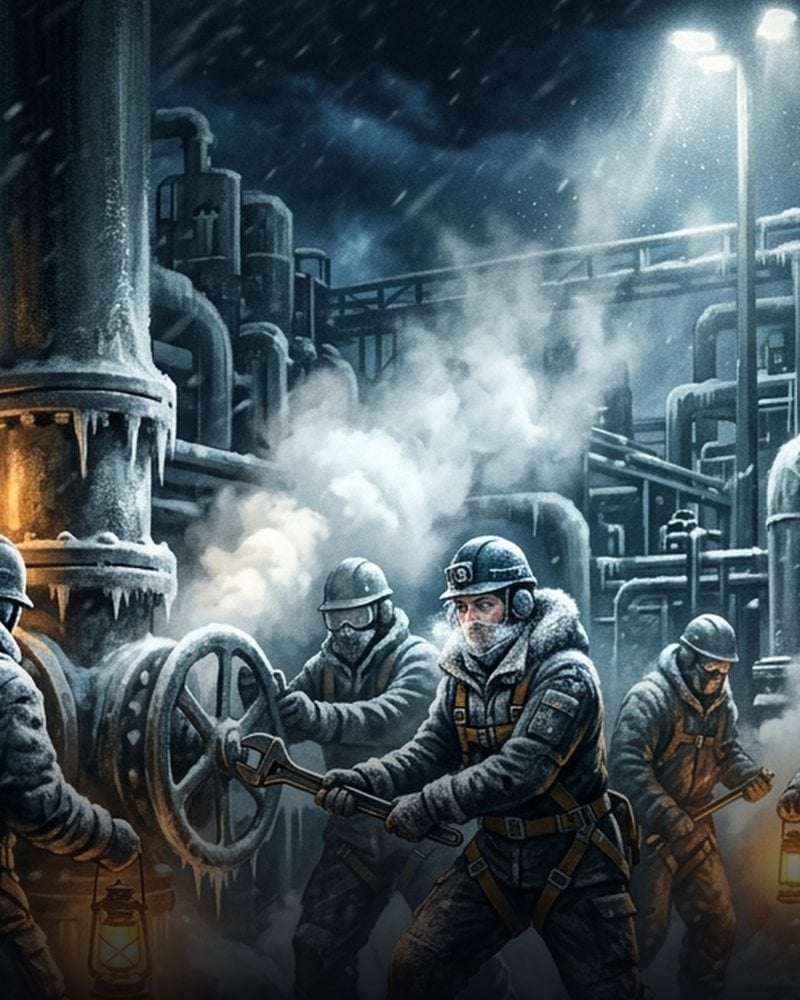
Far to the north, chief technician Helga Magnusdottir and her emergency crew battled a sub-zero blizzard in Reykjavik, manually wrenching open geothermal bypass valves by hand lantern to keep the city's district heating operational after automated regulators froze.
Sub-Zero Stalls and Analog Sentinels
Across the frozen expanse of the North Atlantic, the early hours of the new millennium demanded a return to raw muscle and copper-linked ingenuity. As gale-force winds and blowing snow battered the Icelandic capital, Reykjavik's municipal heating infrastructure faced its most severe test since the turnover. With digital temperature regulators locked up by century-date logic errors, high-pressure steam mains threatened to rupture across the district heating grid. Chief technician Helga Magnusdottir and a rotating squad of maintenance workers braved the freezing outdoor catwalks, using heavy steel wrenches and hand lanterns to manually cycle the main geothermal distribution valves and stabilize water temperatures for thousands of residential homes.
Hours later, far to the southeast in the vaulted chambers of Vienna's central post and telegraph office, senior technical engineers maintained a tense, round-the-clock vigil over legacy plug-board routing banks. In the dead of night, an automated warning bell signaled an unauthorized carrier frequency attempting to bridge the international trunk lines via an 1899 military telegraph protocol. Using brass jumper cables and a dead-end analog loop, the duty engineers successfully trapped the incoming signal source before it could interface with neighboring banking networks, preserving the integrity of Austria's isolated telecommunications perimeter against an invisible digital intrusion.
Ledgers, Barter, and Waterfront Tensions
As morning broke across continental Europe and the southern seas, the collapse of automated electronic networks forced regional markets into a starkly physical reality. In southern Germany, industrial guilds pioneered decentralized barter agreements to sustain manufacturing output as standard interbank settlement channels remained paralyzed by unparsed century date entries. Representatives from Swabian textile weaving houses met through the night with Ruhr coal delegates at the Stuttgart clearinghouse, establishing a direct exchange rate between unwashed wool bales and railway coal warrants. Transactions were painstakingly recorded on heavy parchment ledgers locked in fireproof safes, bypassing Frankfurt's disabled digital clearing mainframes entirely.
Later that morning in the Nordic trade hubs, the Stockholm Mercantile Exchange took radical physical steps to keep regional commerce alive while automated exchange feeds remained locked in unparseable date loops. Four newly constructed pinewood ledger booths now dominated Gustav Adolfs Torg, staffed by retired customs officers and sworn apprentices who meticulously verified every transaction by hand. Rather than relying on electronic clearing, traders exchanged heavy copper tallies backed by stamped parchment certificates, authenticated on the spot with molten red wax and deeply carved boxwood seals to prevent counterfeiting amidst the broader financial freeze.
Half a world away under the hazy morning sun of Valparaiso harbor, customs officials abandoned automated crane manifests in favor of traditional brass balance scales and notched wooden tally sticks. When a heavily loaded lighter operated by the Valparaiso Export Syndicate attempted to offload unmanifested copper ingots without a stamped assay slip on the salt-crusted southern mole, port inspectors immediately impounded the vessel against the stone quay. The dispute drew an angry crowd of dockworkers and shipping clerks, forcing local port authorities to arbitrate the cargo weights by hand while armed carabineros maintained strict order along the waterfront, leaving the true provenance of the impounded metal still heavily contested as the tide began to turn.