
Chapter 26
The Third-Floor Ledger and the Blind Corridor
November 21, 2026
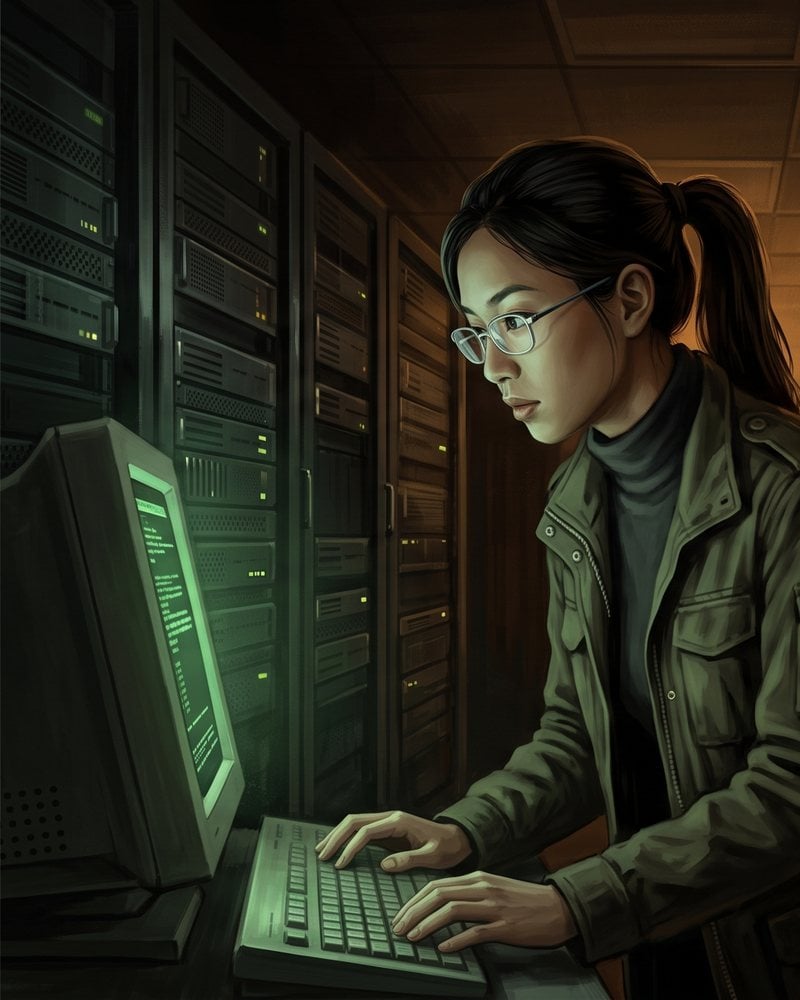
Gabriel Vance reviewed morning security feeds from the distribution hub, spotting a familiar, shadowy watcher lingering near the perimeter fence during an unrecorded bay four delivery who shared the exact same posture as a man from a 1994 photograph with Dr. Alistair Finch.
The morning sun cut sharp, dust-motes-and-all diagonals across the third-floor periodicals alcove of the university library, illuminating stacks of academic journals left unread for weeks. Maya Lin walked between the towering wooden shelves, her mind still turning over the implications of the unrecorded midnight delivery at bay four. As she rounded the corner near the south-facing tall windows, she noticed something anomalous: an open ledger left unattended on a corner study table, its spine cracked flat against the oak. She approached cautiously, glancing around the empty alcove before looking down at the open pages. Her breath hitched. The margins were scrawled with sharp, angular handwriting—the unmistakable, sloping hand of Dr. Alistair Finch. Thumbing through the entries, she realized these were not ordinary academic notes; they were logistical delivery schedules, complete with specific dates, crate weights, and warehouse designations that intersected precisely with the irregular freight manifests she and Gabriel had been tracking.
Clutching the recovered ledger to her chest, Maya stepped out into the quiet third-floor corridor, intending to carry her find down toward the administrative records wing to cross-reference the shipment numbers. The hallway was hushed, muffled by thick carpeting and the amber glow of wall sconces. Just as she approached the heavy wooden double doors of the faculty lounge, the oak portal pushed outward with a faint, oiled creak. Dr. Alistair Finch stepped over the threshold, adjusting the tweed lapel of his jacket and pausing to check the silver wristwatch on his wrist. Maya reacted on instinct, slipping silently into the shadowed alcove beside the cork bulletin board just as Finch turned his head. For a heartbeat, they were separated only by the swinging motion of the door and a few feet of empty air. Finch stared down the corridor, his brow furrowed in a brief, passing frown, before he pivoted on his heel and walked away toward the faculty elevator. Maya stood motionless in the alcove, her fingers pressed hard against the cover of Finch's ledger, her pulse hammering against her ribs as the elevator doors chimed softly down the hall.
When the silence settled back over the third floor, Maya made her way inside the deserted faculty lounge to steady her nerves and grab a quick cup of black coffee from the self-serve counter. The room smelled of scorched chicory and old paper. Reaching across the counter toward the porcelain condiment caddy for a packet of raw sugar, her fingertips brushed against a hard, flat piece of brushed metal wedged neatly out of sight behind the ceramic base. She pulled it free, squinting down at the object in the dim light. It was a standard-issue university electronic keycard, entirely blank—no name, no departmental code, no barcode printed on its clean white plastic surface. Out of sheer professional curiosity, she pressed it against her pocket diagnostic reader. The tiny LED flashed green, emitting a short, coded cryptographic handshake ping: the exact authorization sequence required to bypass the electronic deadbolts on the restricted basement sub-panels where the university's altered municipal archives were currently kept under lock and key.