
Chapter 17
The Bindery Vault Standoff and the Encrypted Archive
November 11, 2026
Back on campus, Provost Julian Thorne summoned head librarian Martha Vance to his executive office to demand a complete inventory of all compromised volumes before outside oversight could intervene.
The Synthetic Thread and the Service Door
Working late in the Special Collections basement vault under low-intensity preservation lighting, Clara Vance systematically checked the collation of every remaining 1985 municipal volume. The silence of the stacks was heavy, broken only by the occasional rustle of brittle paper as she inspected the signatures. She soon discovered that three contiguous volumes featured non-standard needle gauges and modern synthetic thread identical to the material previously flagged in the water board ledgers, confirming that the forgery operation was far more comprehensive than initially estimated. The tampering was not an isolated incident of a single corrupt year, but part of a systematic, multi-year rewriting of the town's foundational records.
While cataloging the re-stitched quires in the bindery vault, Clara suddenly heard footsteps approaching the service door rather than the main public entrance, followed by a quiet, deliberate knock. Opening it partway, she found an uncommunicative courier holding a clipboard with an explicit requisition slip for the exact 1985 municipal ledger she was currently examining. The courier attempted to claim the volume was marked for routine preservation rotation, creating a tense standoff in the dimly lit hallway. Recognizing the transparent ruse, Clara held her ground, refused the handover, and shut the heavy metal door against the courier's demands, leaving the quiet corridor echoing with unresolved tension as she secured the ledger back inside the vault.
Off-Site Backups and the Institutional Purge
Following Clara's discoveries in the bindery vault, head librarian Martha Vance recognized that internal university servers and administrative oversight were thoroughly compromised by Provost Thorne's office and Dr. Alistair Finch's department. Knowing that any physical inventory demanded by the administration would likely be used to curate and sanitize the evidence rather than expose it, Martha took the calculated risk of bypassing standard protocols entirely.
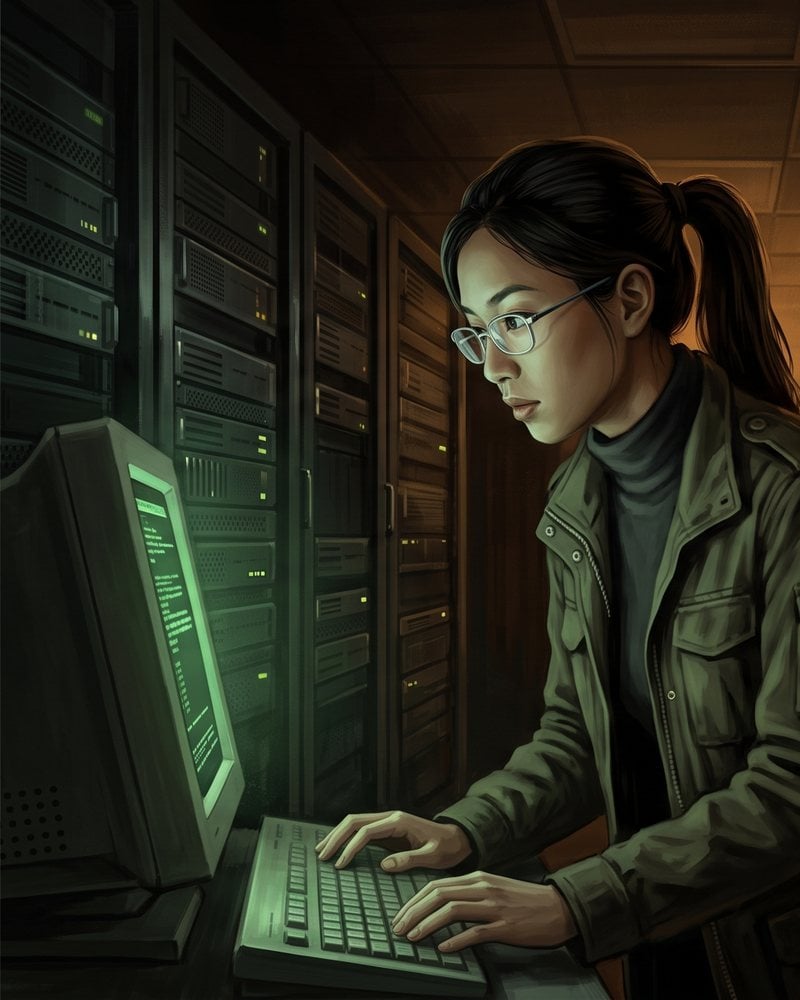
Working in her private office after hours, she loaded high-resolution digital scans of the 1984 and 1985 altered ledgers onto a personal encrypted drive. With quiet determination, she began exporting the files to an independent, off-site cloud repository to ensure the historical discrepancies survived any impending institutional purge. As the progress bar ticked slowly upward on her screen, the weight of what she was doing settled over her—she was actively defying the university's executive leadership, opening a silent front in a war for the town's history that was rapidly running out of places to hide.