
Chapter 8
Subterranean Ledgers and Plexiglass Horizons Across Global Networks
January 1, 2000, 11:20 CET
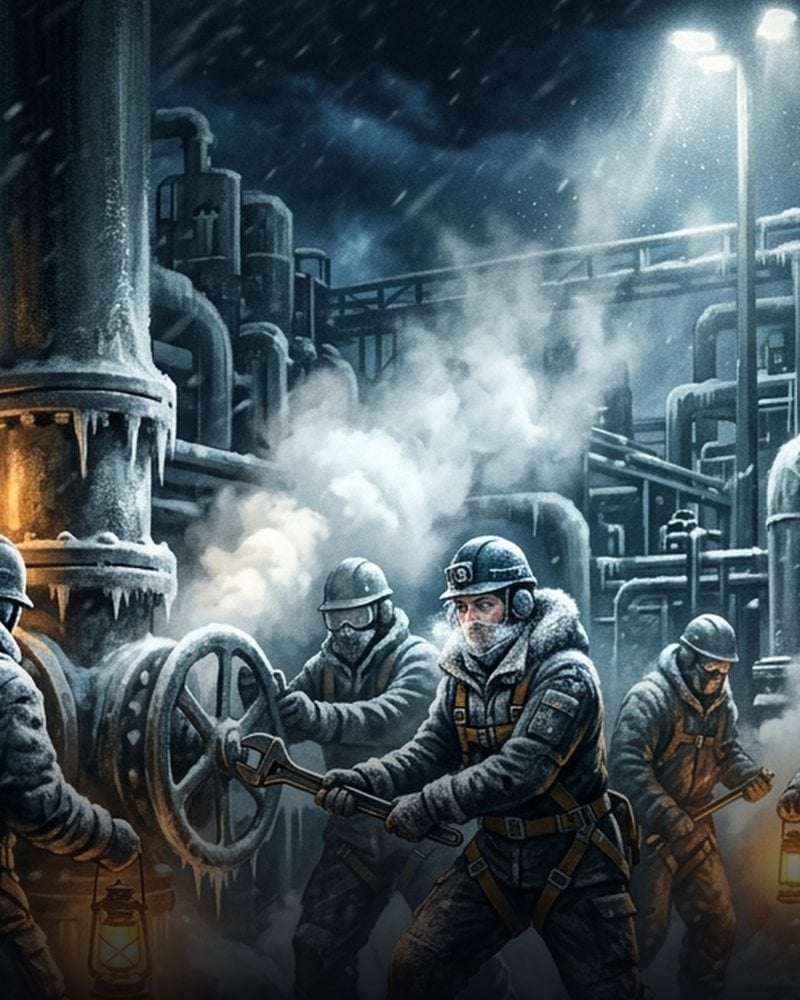
As sub-zero winter winds bit deep into Stockholm, grid operators fought a desperate manual battle at analog feeder switches to stave off a capital-wide blackout.
Vaults and Trading Floors in Central Europe
Beneath the stone-paved quiet of Paradeplatz, the subterranean clearing vaults of Zurich echoed with the dry rustle of heavy paper. Central bank delegates and commercial auditors gathered around massive steel tables, their breath misting slightly in the chilled air of the underground rooms. Swiss National Bank officials oversaw the painstaking manual verification of overnight multi-currency transactions, forced to reconstruct international wire transfers halted entirely by fatal date-logic errors. With automated SWIFT message parsing completely suspended due to unparseable century tokens, senior clerks cross-referenced endless rolls of telex confirmation printouts with bound physical account books, each transaction a potential fault line in the global monetary framework.
Several hours later in Frankfurt, high-security computer rooms hummed with an anxious tension as lead systems auditor Greta Weber made a startling discovery. Inside the core infrastructure of the Deutsche Börse, secondary automated execution pipelines had continued to process government bond options using corrupted historical pricing feeds, rolling system clocks back to an 1899 baseline. Worse still, Greta's team uncovered unauthorized automated arbitrage scripts actively attempting to exploit the phantom valuations before regulators could seal the trading floor. The discrepancy threatened to create billions in unaccounted liabilities, demanding immediate manual quarantine protocols across every terminal network before the morning session bled further into chaos.
Signals Across the Veld and Tokyo Bay
As the morning gave way to the early afternoon heat across the South African highveld, the vital rail arteries feeding Johannesburg and surrounding mineral hubs ground to a sudden halt. Automated interlocking systems along the Witwatersrand mining logistics corridor froze flat into default safety stops after central signal computers suffered widespread data packet corruption. Signal maintenance crews led by chief technician Thabo Mokoena deployed urgently to junction boxes scattered across the dusty plains, forced to manually verify track occupancy via field telephones and mechanical semaphore flags to prevent catastrophic collisions on the heavy freight lines.
Hours drifted past as daylight waned into a tense, overcast evening in East Asia, where Haneda Airport approach controllers found themselves staring at flickering, dying screens. Senior watch supervisor Kenji Sato coordinated frantically with Japan Air Self-Defense Force radar stations after civilian automated altitude-encoding processors failed completely, leaving regional feeds dropping altitude data strings on incoming craft. Controllers mapped incoming trans-Pacific flights by hand on massive plexiglass plotting boards, relying entirely on emergency verbal coordination with military airspace monitors to manage cascading holding patterns over the darkened expanse of Tokyo Bay.
Tide and Binoculars at Sydney Harbour
Far to the south as night settled completely over the southern hemisphere, the maritime gateway of Port Jackson faced a mounting logistical crisis. Marine pilots and harbor masters at Sydney Harbour stood on windswept observation decks, peering through hand-held binoculars while harbour police patrol boats cut through the dark water. The automated port berth coordination system had locked up entirely on unparseable arrival timestamps from incoming container ships steaming in from the Tasman Sea, leaving automated crane allocation frozen. Port officials scrambled auxiliary teams equipped with VHF radios and crumpled paper manifests to intercept incoming vessels, manually logging coordinates and directing berths from the water's edge under the indifferent glow of the harbor bridge — an improvised watch that left open the haunting question of how many other automated nodes across the planet were quietly slipping their moorings.