
Chapter 20
Sub-Zero Feeders, Plexiglass Plots, and Frozen Arteries Across Global Nodes
January 6, 2000, 18:00 AEDT
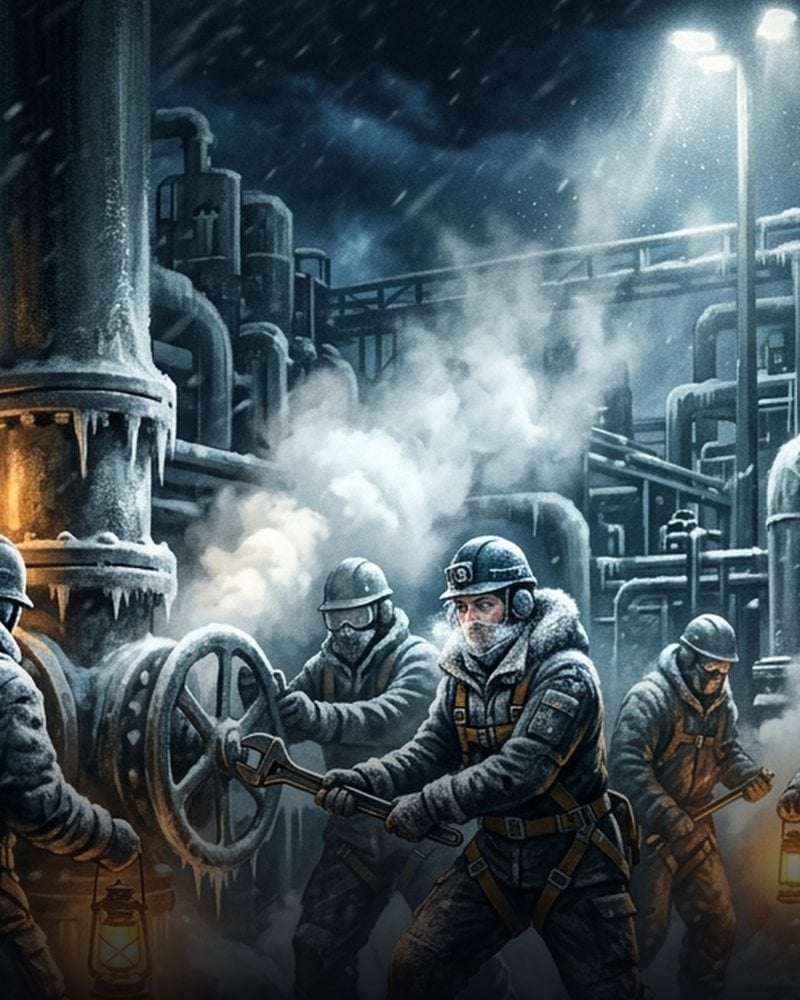
As encrypted audit trails exposed deeper vulnerabilities in legacy banking code, financial institutions found themselves balancing precariously over an abyss of unverified debts.
Sub-Zero Substations and Arctic Splicing
Across the frozen capitals of Northern Europe, the first week of the new millennium arrived not with celebration, but with the raw friction of metal and frost. In Stockholm, engineering crews fought against biting sub-zero gales to manually rotate high-voltage knife switches and cycle emergency substation feeders, stepping in after severe automated load-balancing failures threatened to plunge districts into darkness. The sheer cold seized tools and froze breath in the air, yet the manual intervention kept the residential grid from collapsing under the strain of unmanaged load spikes.
Several hours later off the rugged coast of Norway, telecommunications technicians aboard the cable-laying vessel Skagerrak braved freezing Arctic gales and towering seas near the Lofoten Archipelago. Working on rolling decks under harsh halogen floodlights, the crew completed critical fiber-optic repairs on damaged transatlantic links, splicing severed glass strands to keep the fragile digital tether between Europe and North America alive.
Forensic Freezes and Terminal Skies
As morning light broke over Central Europe, the Swiss National Bank in Zurich escalated its defensive posture. Investigative accountants uncovered further intricate shell company linkages that continued to exploit the persistent 1899 date-string vulnerabilities. The realization that the exploit was embedded deep within structural clearing protocols prompted aggressive account freezing and an expanded mandate for international forensic audits, leaving foreign exchange partners scrambling to verify their liquidity.
Half a world away, as the morning progressed in East Asia, Haneda Airport in Tokyo operated entirely outside the digital age. Civilian air traffic controllers and Japan Air Self-Defense Force radar officers maintained trans-Pacific flight separation using hand-drawn plexiglass plotting boards and voice radio check-ins. With automated altitude data streams completely corrupted by the millennium rollover, the control room hummed with frantic, disciplined radio chatter, relying on grease pencils and steady nerves to guide metal behemoths safely through the clouds.
Frozen Docks and Unverified Manifests
As the global calendar pushed into the evening hours across the Southern Hemisphere, commercial shipping operations at Webb Dock in Melbourne remained entirely paralyzed. The Maritime Union of Australia stood firm, refusing to process unverified container unloading amid hazardous material manifest discrepancies caused by corrupted date stamps. Union representatives inspected garbled paper printouts alongside tense port authorities, unwilling to risk dockside safety on automated systems that could not prove the contents of sealed cargo containers.
In the shadow of the silent cranes, the unresolved standoff highlighted the deepening divide between automated logistics and human verification—leaving essential maritime supply chains frozen in place as the true cost of the millennium bug continued to ripple outward through every layer of global infrastructure.